

Information For Parents

Healthy Eating at St Bertha Daycare Nursery
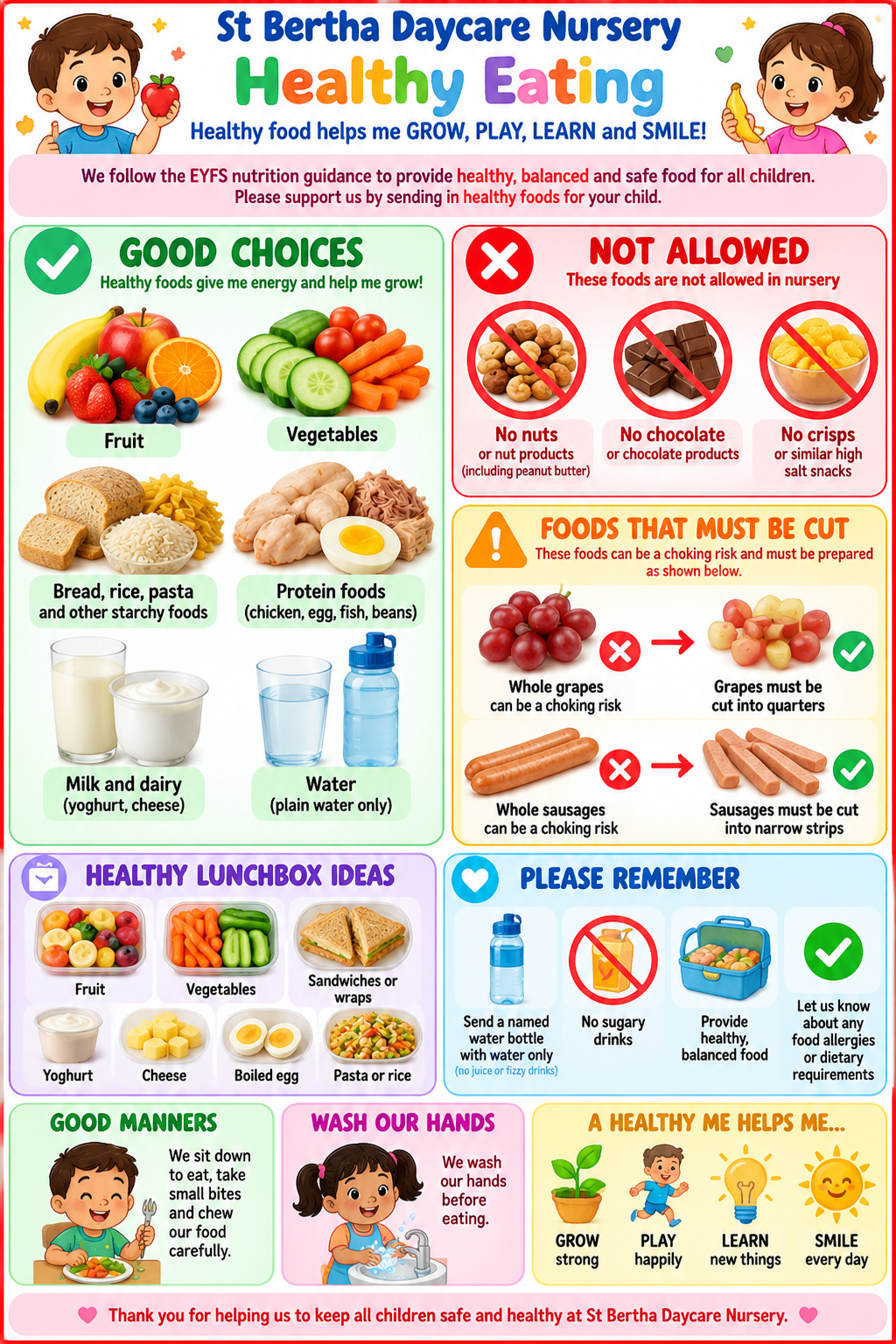
At St Bertha Daycare Nursery, we believe that healthy eating plays an important role in helping children grow, learn, play and thrive. We encourage children to develop positive eating habits from an early age by offering a balanced approach to nutrition, promoting good food choices and making mealtimes enjoyable, safe and social experiences.
Encouraging Healthy Choices
We encourage children to enjoy a variety of nutritious foods, including fresh fruit and vegetables, bread, rice, pasta and other starchy foods, protein-rich foods such as chicken, fish, eggs and beans, and dairy products such as milk, yoghurt and cheese. We also encourage children to drink plenty of plain water throughout the day to stay hydrated.
Through everyday routines and positive role modelling, we help children explore different foods, develop independence and understand how healthy choices support their growth, energy and wellbeing.
Healthy Lunchboxes
We ask parents and carers to provide balanced, nutritious lunchboxes that support their child’s development and energy levels throughout the day. Suitable options include:
Fresh fruit and vegetables
Sandwiches or wraps
Pasta or rice dishes
Yoghurt and cheese
Hard-boiled eggs and other suitable protein foods
A named water bottle containing plain water only
Please do not send sugary drinks, crisps or similar high-salt snacks, chocolate or chocolate products, nuts or nut-containing products, including peanut butter. These restrictions help us maintain a consistent approach to children’s health and safety.
Keeping Mealtimes Safe
Children’s safety is our priority. Foods that may present a choking risk must be prepared appropriately for each child’s age and developmental stage. For example, grapes must be cut lengthways into quarters, and sausages must be cut lengthways into narrow strips. Staff remain mindful of choking hazards and supervise children carefully during mealtimes.
Developing Good Eating Habits
We encourage children to sit down while eating, take small bites and chew their food carefully. Children are supported to explore new foods at their own pace in a calm, positive environment, helping them build confidence and develop a healthy relationship with food.
Handwashing is also an important part of our daily routine. Children are encouraged to wash their hands before eating to promote good hygiene and help prevent the spread of germs.
Working in Partnership with Families
We value our partnership with parents and carers in supporting every child’s health and wellbeing. Please inform us of any food allergies, intolerances, dietary requirements or cultural food preferences so that we can work together to meet your child’s individual needs and keep them safe.
At St Bertha Daycare Nursery, healthy eating is about more than food. It is about helping every child grow strong, play happily, learn new things and smile every day.
Thank you for working with us to keep all our children safe, healthy and happy.
Choking Prevention and Safe Food Preparation
At St Bertha Daycare Nursery, children’s safety is always our priority. We ask all parents and carers to ensure that food sent into nursery is prepared safely to reduce the risk of choking. Children must always be seated while eating and supervised by an adult.
Foods that must be cut or prepared carefully
Grapes, cherry tomatoes and small round fruits: Cut lengthways and then into quarters. Never serve whole.
Sausages and hot dogs: Remove the skin where appropriate and cut lengthways into thin, narrow strips rather than round pieces.
Carrots and other hard vegetables: Grate, cook until soft or cut into narrow batons suitable for the child’s age and ability.
Apples and other firm fruits: Cut into thin slices or soften by cooking. Avoid hard chunks.
Cucumber, peppers and celery: Cut into narrow strips or batons suitable for the child’s developmental stage.
Cheese: Grate or cut into short, narrow strips rather than large cubes.
Meat and fish: Cut into thin, manageable strips and remove all bones, tough skin and excess fat.
Bread, sandwiches and wraps: Cut into manageable strips or pieces. Lightly toasting white bread may help reduce its doughy texture.
Chickpeas, beans and similar foods: Mash or soften where necessary, particularly for younger children.
Berries and strawberries: Cut small, round fruits lengthways and into quarters where appropriate. Remove any hard stalks and check for firm pieces.
Dried fruit: Prepare appropriately for the child’s age. Do not give whole raisins or dried fruit to babies under 12 months.
Foods that must not be provided
To reduce choking risks, the following foods must not be sent into nursery:
Whole nuts and whole peanuts for children under five.
Popcorn.
Marshmallows.
Hard sweets and boiled sweets.
Raw jelly cubes.
Chewing gum.
Whole grapes or whole cherry tomatoes.
Peanut butter served on its own.
Our mealtime safety rules
Children must sit upright while eating.
Children must never eat while running, walking or playing.
Staff will supervise children closely throughout meals and snacks.
Food must be age-appropriate and prepared according to each child’s individual needs.
Parents must inform the nursery of any allergies, intolerances, swallowing difficulties or special dietary requirements.
We ask all families to work with us to maintain these safety practices, helping every child enjoy their food in a safe, calm and supportive environment.
Our Overall EYFS Curriculum
OUR CURRICULUM INTENT
We provide a safe, nurturing and inclusive EYFS curriculum where every child is known, valued and supported from their starting point. We build strong foundations for communication, relationships, independence, health, learning and school readiness.
HOW CHILDREN LEARN
Through warm relationships, play, routines, stories, songs, conversations, exploration, outdoor learning and carefully planned adult interactions. We follow interests while intentionally introducing knowledge, vocabulary, skills and challenge.
HOW WE KNOW CHILDREN ARE LEARNING
We know starting points, observe children in meaningful everyday experiences, listen to families, identify strengths and next steps, and adapt teaching. Assessment supports learning and inclusion rather than unnecessary paperwork.
CURRICULUM PROGRESSION THROUGH THE NURSERY
BABY ROOM
Secure attachments • responsive care • early communication • sensory exploration • movement • safe sleep • self-help beginnings • predictable routines.
2-YEAR-OLD ROOM
Communication • emotional security • friendships • physical development • independence • self-care • stories, songs, sensory play and simple problem-solving.
MAIN HALL — 3–4 YEARS
Longer conversations • self-regulation • independence • early literacy and maths • curiosity • outdoor learning • creative expression • sustained shared thinking.
PRESCHOOL / NEXT STAGE
Confidence and school readiness • richer vocabulary • listening and attention • early reading/writing • mathematical thinking • independence • resilience • wider-world knowledge.
THE 7 EYFS AREAS ACROSS THE WHOLE NURSERY
1. COMMUNICATION & LANGUAGE — Prime
Rich conversations, stories, songs, questions, new vocabulary, listening and understanding.
2. PERSONAL, SOCIAL & EMOTIONAL DEVELOPMENT — Prime
Relationships, confidence, self-regulation, independence, friendships, empathy and positive behaviour.
3. PHYSICAL DEVELOPMENT — Prime
Gross and fine motor skills, coordination, movement, healthy choices and personal care.
4. LITERACY — Specific
Books, stories, rhyme, sounds, phonological awareness, print, mark-making and early writing.
5. MATHEMATICS — Specific
Counting, quantities, comparison, sorting, pattern, shape, space, measure and problem-solving.
6. UNDERSTANDING THE WORLD — Specific
People, families, communities, nature, seasons, living things, materials, technology and the wider world.
7. EXPRESSIVE ARTS & DESIGN — Specific
Music, singing, dance, role play, imagination, art, design, construction and creative materials.
WHAT WE PROMISE EVERY CHILD
To feel safe, secure, respected and included.
To build trusting relationships and positive friendships.
To have daily opportunities to talk, listen, play, explore, move, create and investigate.
To have their interests, culture, family, language, strengths and individual needs valued.
To receive appropriate support for SEND, EAL and individual developmental needs.
To develop independence, resilience, confidence, curiosity and the skills needed for their next stage.
WORKING WITH FAMILIES • INCLUSION • SAFEGUARDING • HEALTH & WELLBEING • SCHOOL READINESS